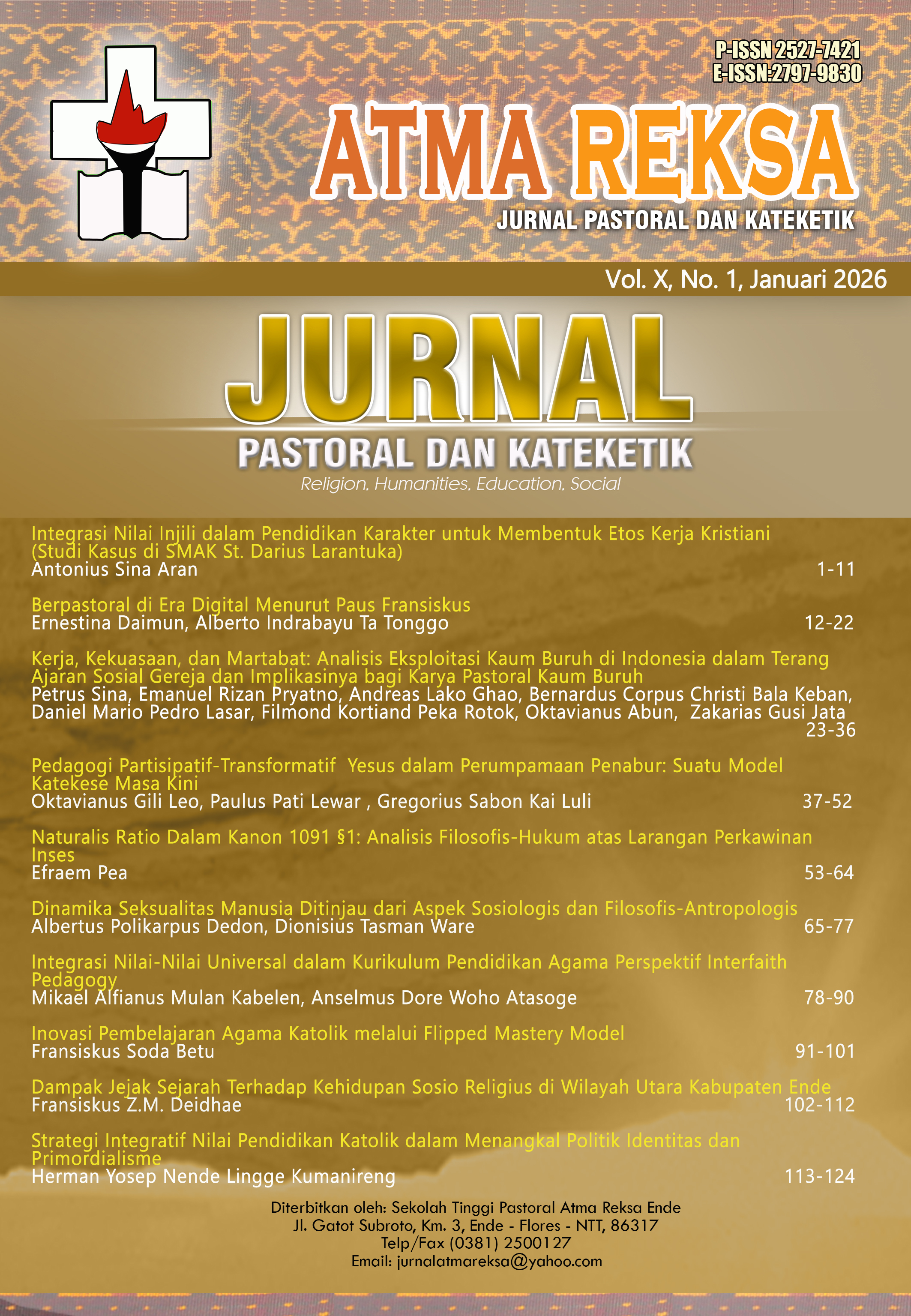
Pedagogi Partisipatif-Transformatif Yesus dalam Perumpamaan Penabur: Suatu Model Katekese Masa Kini
DOI:
https://doi.org/10.53949/arjpk.v10i1.87Keywords:
Parable of the Sower, Catechetical Pedagogy, Faith Response, Faith GrowthAbstract
The research is grounded in contemporary catechetical challenges, including fragmented attention, a lack of deep faith internalization, and difficulties in assimilating teachings—factors that highlight the need for methodological renewal. This study aims to formulate an effective and relevant catechetical pedagogical model by analyzing the teaching dimensions of Jesus in the Parable of the Sower (Matt 13:1-23; Mark 4:1-20; Luke 8:4-15). Employing a qualitative descriptive-analytical method, this study examines the parable’s literary context, historical background, and narrative structure, and identifies the implicit pedagogical principles it contains. The findings reveal that Jesus’ catechesis represents a participatory and transformational pedagogical model that prioritizes the quality of the listener’s heart response (receptivity) as the “soil,” rather than merely the transmission of information (the Seed/Word). This model generates five core principles: contextualization, dialogue, process, participation, and transformation. The pastoral implications encourage parishes to adopt experience- and community-based catechesis, equip catechists to become patient and diagnostically attuned sowers, and strengthen the role of parents as the primary sowers of faith. This model affirms that authentic faith growth requires perseverance and personal responsibility in cultivating the “soil of the heart” so that it may bear abundant fruit (thirty-, sixty-, or a hundredfold).
References
Adiatma, D. L. (2022). Ciri Khas Pengajaran Yesus dengan Metode Perumpamaan Berdasarkan Catatan Injil Sinoptik. HUPERETĒS: Jurnal Teologi dan Pendidikan Kristen, 3(2), 127-137. https://doi.org/10.46817/huperetes.v3i2.115.
Akpan, A. M., & Viljoen, F. P. (2021). Guidelines Towards Plausible Interpretation of Gospel Parables. In die Skriflig/In Luce Verbi, 55(1), a2701. https://doi.org/10.4102/ids.v55i1.2701.
Asmara, A. H. D. (2024). Katekese Transformatif-Imaginatif: Identitas Ilmu Kateketik di Zaman yang Berubah. Jurnal Umat Baru, 1(01), 33-53. https://doi.org/10.24071/ub.v1i1.10255.
Barclay, W. Pemahaman Alkitab Setiap Hari: Injil Matius Pasal 11-28. Jakarta: BPK Gunung Mulia, 2015.
Bhodo, Y. D. (2017). Katekis di Tengah Gaya Hidup Modern: Ibarat Berpastoral di Antara ‘Lalang’ dan ‘Gandum’. Atma Reksa: Jurnal Pastoral dan Kateketik, 2(1), 60-69. https://scholar.archive.org/work/eali66pyznalriobpfyxahnlpa/access/wayback/http://jurnal.stiparende.ac.id:80/index.php/jar/article/download/23/23.
Borg, M. J. (2009). Jesus: A New Vision. New York: HarperCollins.
Christi, T. T. (2022). Perumpamaan tentang Penabur Sebagai Kunci Memahami Esensi Kerajaan Allah. Jurnal Teologi Berita Hidup, 4(2), 575-590. https://e-journal.sttberitahidup.ac.id/index.php/jbh/article/download/266/162.
Craddock, F. B. (2002). Overhearing the Gospel. (Fourth edition). Missouri: Chalice Press.
Crossan, J. D. (2002). The Parables of Jesus. Interpretation: A Journal of Bible and Theology, 56(3), 247-259. https://journals.sagepub.com/doi/abs/10.1177/002096430005600302.
Darmadi, D. (2021). Metode Mengajar Yesus dalam Injil Matius dan Penerapannya dalam Pendidikan Kristen Masa Kini. KALUTEROS: Jurnal Teologi dan Pendidikan Kristen, 3(2), 1-35. https://doi.org/10.60146/.v3i2.30.
Friyanti, V., & Gurning, L. (2024). Model Pengajaran Tuhan Yesus: Pendekatan Pembelajaran Berbasis Nilai dan Kasih. Jurnal Pendidikan Kristiani dan Kateketik Katolik, 1(3), 13-22. https://doi.org/10.61132/anugerah.v1i3.44.
Halawa, Y., Laia, S., & Bambangan, M. (2025). Implementasi Seorang Penabur Bagi Umat Kristen di Era Postmodern: Kajian Teologis Markus 4:1-20. Jurnal Teologi Injili dan Pendidikan Agama, 3(1), 51-62. https://doi.org/10.55606/jutipa.v3i1.422.
Hardin, L. T. (2024). “So That They Might Turn”: The Possibility of Repentance in Jesus' Parables. Religions, 15(12), 1424. https://doi.org/10.3390/rel15121424.
Jeremias, J. (1972). The Parables of Jesus. (Second Revised Edition). New York: Charles Scribner's Sons.
Legi, R. E., Tolego, Y. B., Lumantow, A. I. S., & Rumetor, J. J. (2025). Pendidikan Agama Kristen Dewasa: Tantangan, Strategi, dan Implikasi Bagi Pengembangan Spiritualitas dalam Konteks Sosial-Budaya Modern. Jurnal Teologi Injili, 5(1), 38–56. https://doi.org/10.55626/jti.v5i1.165.
Mega, C. K., & Saingo, Y. A. (2025). Analisis Model Pengajaran Yesus dengan Pola Perumpamaan (Parables of Teaching). Sinar Kasih: Jurnal Pendidikan Agama dan Filsafat, 3(2), 107-121. https://doi.org/10.55606/sinarkasih.v2i2.325.
Murphy, D. D. (2023). Worship as Catechesis: Knowledge, Desire, and Christian Formation. Theology Today, 58(3), 321-332. https://doi.org/10.1177/004057360105800304.
Nikolaus, Andi, Y., & Harming. (2020). Perumpamaan Penabur Benih Sebagai Pendekatan Misi Lintas Budaya Berdasarkan Markus 4:1-20. INTEGRITAS: Jurnal Teologi, 2(1), 11-20. https://doi.org/10.47628/ijt.v2i1.18.
Sani, M. F. S., & Pius X, I. (2024). Menghadapi Tantangan Modern: Katekese Kontekstual untuk Mahasiswa Calon Katekis. Sinar Kasih: Jurnal Pendidikan Agama dan Filsafat, 2(1), 133-142. https://doi.org/10.55606/sinarkasih.v2i1.252.
Saputra, Y. C. K. (2024). Mengintegrasikan Katekese, Pastoral, dan Tindakan Sosial: Model Pendampingan Katekis untuk Menciptakan Transformasi Umat. SAPA: Jurnal Kateketik dan Pastoral, 09(02), 156-173. https://doi.org/10.53544/sapa/v9i2.
Sarma, A., & Tarihoran, E. (2024). Transformasi Katekese Kontekstual Menuju Era Digital: Implikasi dan Tantanganya. VOCAT: Jurnal Pendidikan Katolik, 4(1), 1-12. https://doi.org/10.52075/vctjpk.v4i1.431.
Scheunemann, R. (2012). Kingdom Of God: Tafsiran Perumpamaan-Perumpamaan Tuhan Yesus. Yogyakarta: Penerbit ANDI.
Simanjuntak, M., & Rahayu, R. S. (2025). Implementasi Perumpamaan Penabur dalam Matius 13:18-23 bagi Pertumbuhan Iman Jemaat. NIRWASITA: Jurnal Pendidikan dan Pembelajaran, 4(2), 17-27. https://widyasari-press.com/wp-content/uploads/2025/05/3.-Maida-Simanjuntak-IMPLEMENTASI-PERUMPAMAAN-PENABUR-DALAM-MATIUS-13-18-23-BAGI-PERTUMBUHAN-IMAN-.pdf.
Sinaga, B. A. (2025). Krisis Identitas Iman di Kalangan Mahasiswa Kristen: Tantangan bagi Pendidikan Agama Kristen di Era Digital. CHARISMO: Jurnal Teologi dan Pendidikan Agama Kristen, 4(1), 12-23. https://ejournal.sttpresbyterianmedan.ac.id/index.php/charismo/article/view/90.
Tanasyah, Y., & Simanungkalit, L. N. (2020). Parables as an Effective Learning Model for the Process of Learning in Christian Education. QUAERENS: Journal of Theology and Christianity Studies, 2(1), 30-43. https://doi.org/10.46362/quaerens.v2i1.18.
Tim Penulis Komisi Kateketik KWI. (2024). Iman dan Katekese. Yogyakarta: Penerbit PT Kanisius.
Van Eck, E. (2014). The Harvest and the Kingdom: An Interpretation of the Sower (Mk 4:3b-8) as a Parable of Jesus the Galilean. HTS Teologiese Studies/Theological Studies, 70(1), Art. #2715, 10 pages. https://doi.org/10.4102/hts.v70i1.2715.
Viljoen, F. P. (2019). Why Jesus Spoke in Parables. In die Skriflig/In Luce Verbi, 53(1), a2523. https://doi.org/10.4102/ids.v53i1.2523.
Zimmermann, R. (2009). How to Understand the Parables of Jesus: A Paradigm Shift in Parable Exegesis. Acta Theologica, 29(1), 157-182. https://doi.org/10.4314/actat.v29i1.44175.
Downloads
Published
How to Cite
Issue
Section
License
Copyright (c) 2026 Oktavianus Gili Leo, Paulus Pati Lewar , Gregorius Sabon Kai Luli

This work is licensed under a Creative Commons Attribution-NonCommercial-ShareAlike 4.0 International License.